The ‘HOVORY’ project launches in Zaporizhzhia: 90 schools to join in developing a child safety system
Following the successful roll-out of the ‘HOVORY’ project by the UCU Child Dignity Centre in schools across the Lviv community, it will now be implemented in 90 educational institutions in the city of Zaporizhzhia. There, research will be carried out into children’s subjective sense of safety, child protection standards for the education sector will be developed, training will be provided for educators, school teams will be familiarised with the project’s tools, and personal safety lessons will be organised for pupils.

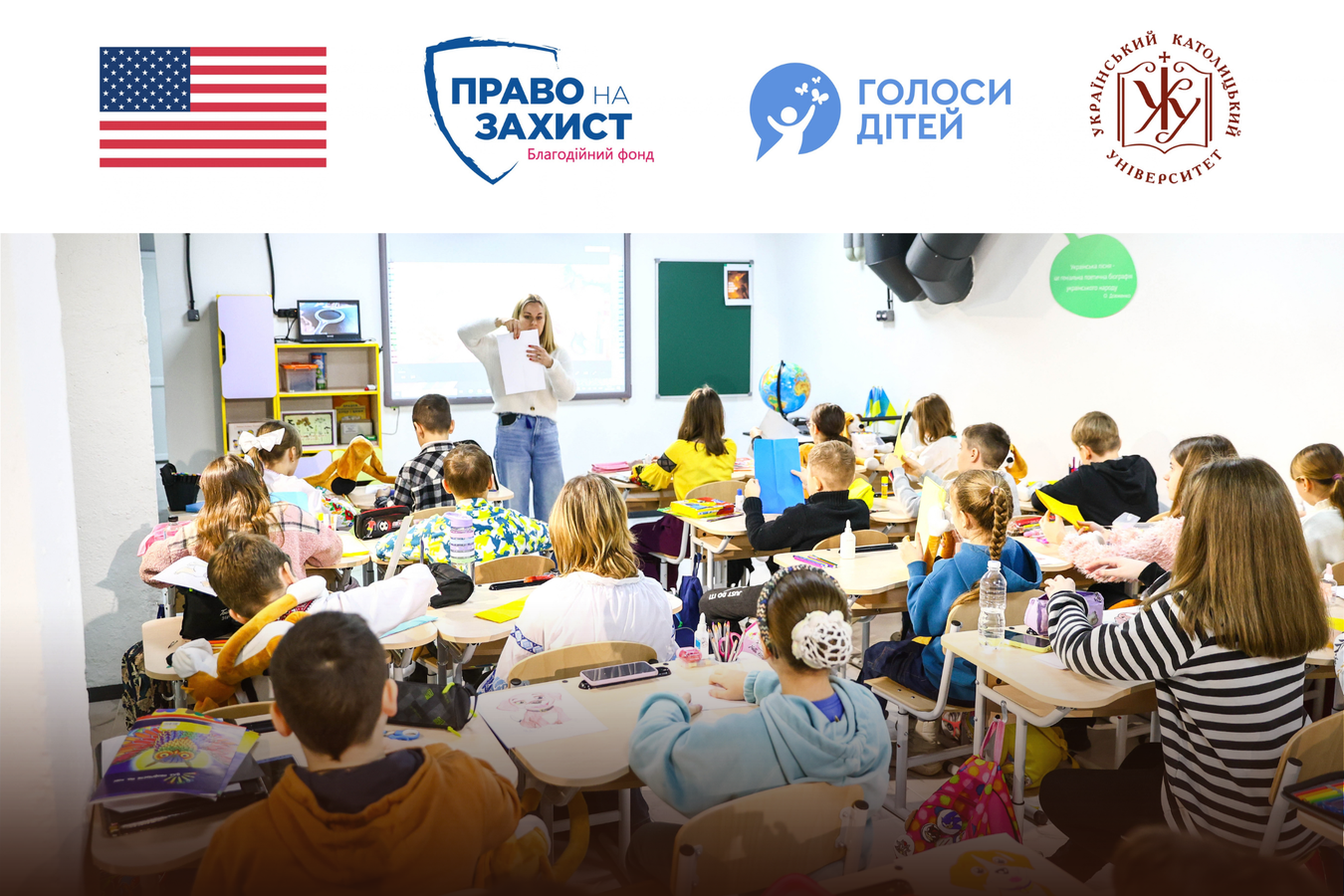
‘No child living in Ukraine today is objectively safe. But it turns out that they can subjectively feel safe, regardless of whether they are in relatively safe places or in towns near the front line,” notes Khrystyna Shabat, head of the UCU Child Dignity Centre. “Research shows that children can feel safe if there are safe adults around them. It is important for them to have friends and adults with whom they can discuss difficult issues.”
‘HOVORY’ is a comprehensive model that helps schools create an environment in which child safety is part of the everyday culture and interactions between children and adults. The model aims to prevent violence, identify risks at an early stage, ensure children seek help in good time, and enable adults to respond sensitively.
Last academic year, 131 schools in the Lviv community introduced the ‘GOVORY’ programme. 4,030 educators underwent training on creating a safe environment for children, and around 80,000 pupils attended lessons on personal safety.
Natalia Tarnovska, head of projects and programs in the Education direction at the UCU Child Dignity Centre, points out that a culture of safety for children at school is not created by a single lesson, a poster or simply an emergency button. It emerges when an educational institution has a comprehensive protection system: clear rules of conduct, trained adults, a designated safety officer, and a mechanism for seeking help that is clear and simple for a child to understand. It also involves regular discussions with children about personal boundaries, tackling bullying, online safety and the right to seek help when something is troubling them.
“Of course, systemic change is only possible in partnership with local authorities, the education department and school administrations. In our pilot project in Lviv, it was precisely this collaboration with the city that enabled us to implement the model not just in individual schools, but across the entire community. We are taking this approach with us to Zaporizhzhia and are already delighted with the promising start to our collaboration with the Zaporizhzhia City Council and the Zaporizhzhia City Department of Education and Science,” emphasises Nataliia Tarnovska.
The Ukrainian Catholic University has signed a memorandum of cooperation with the Zaporizhzhia City Council to implement the ‘HOVORY’ model as a comprehensive system for creating a safe educational environment for children.
As of September 2026, 90 schools in Zaporizhzhia are operating on a face-to-face basis with a blended learning model, 12 of which are located underground. There are currently around 40,000 schoolchildren in the city.
“For Zaporizhzhia, children’s safety is one of our key responsibilities. As a city on the front line, we work every day to ensure that, even in wartime, children can learn, socialise and feel protected. But a safe environment is about more than just walls. It also means that a child knows who to turn to in the event of bullying, violence or any other difficult situation, where teachers have clear protocols for action, and safety rules are understood by children, parents and school staff,” emphasises Regina Kharchenko, acting mayor of Zaporizhzhia.
She adds that this is precisely why it is so important for the city to implement the ‘HOVORY’ project.
“It helps to foster a systematic culture of safety, rather than merely reacting to isolated incidents of violence. Zaporizhzhia is already a leader in education. We live in one of the most challenging realities for children, yet at the same time we have the opportunity to set safety standards that can serve as an example for other cities. Our task is to ensure that school is a space for development, not fear. We cannot eliminate all the risks of war, but we can do everything to ensure that every child knows there are adults nearby who will protect, listen to and help them,” emphasises Regina Kharchenko.
Andriy Khmelnytskyi, Deputy Director of the Department of Education and Science at Zaporizhzhia City Council, stresses: “For us, a child’s safety is not just about being in a sheltered building during an alarm. Sometimes a child faces a problem or a difficult situation. They do not always know how to talk about it openly. That is why it is important for educational institutions to foster an atmosphere of open communication, so that teachers can understand, support and guide the child. This is precisely why the ‘HOVORY’ project is so important to us.”
As part of the project, research will be carried out into children’s subjective sense of safety in schools in Zaporizhzhia. Based on the results, the ‘GOVORI’ model will be adapted to the challenges faced by a city near the front line, and child protection standards will be developed for educational institutions. Each school will appoint safety officers, who will undergo training from experts at the Centre for Child Dignity. Personal safety lessons will also be held for all pupils.
This publication was made possible by the generous support of the Government of the United States of America. The Ukrainian Catholic University is responsible for the content, which does not necessarily reflect the views of the Government of the United States of America.